Animals

Monday, 23 February 2026
23 facts about Narwhal
Sea unicorn
Monodon Monoceros, or single-tooth narwhal, is the only representative of the genus Monodon from the Monodontidae family. These relatively small mamma ...

Did you know?

Alpaca
There are two breeds of alpacas: suri and huacaya, which differ in their coat.
The suri's hair grows up to 50 cm long and grows along the body, while the huacaya's hair grows perpendicular to the body. Both breeds can be found in captivity, but the suri is less popular.
Central bearded dragon
A bearded dragon can live up to 20 years in captivity.
The average lifespan of these lizards in the wild is about 11 years.
Malaysian trumpet snail
Malaysian trumpet snail, also known as the red-rimmed melania, is a freshwater snail of the family Thiaridae.
Earthworms
Earthworms, depending on the species, can reach a length of 1 centimeter to 1 meter.
Great spotted woodpecker
They drink the sap of birch trees.
In spring, woodpeckers pierce the bark of birch trees and drink the sap that flows from the trunk.
Ladybugs
Ladybirds lay their eggs in clusters, usually in an area rich in aphids.
They are known for laying both fertile and infertile eggs. The reason is that it rises the chance of survival for larvae that hatch from fertile eggs.
Zebra mussel
They are medium size clams, which adult forms can grow up to 5,1 cm.
Average specimen dimensions are between 25 to 40 mm in length, 13 to 18 mm in height and 17 to 23 mm in width.
Black Caiman
They are carnivores.
They feed on anything brave enough to venture near their territory, including monkeys, cattle, giant ...
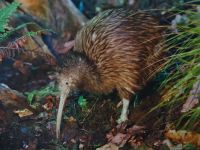
Kiwi bird
Kiwi are sexually dimorphic.
Females are approximately 20% larger than males.
Platypus
It has a characteristic beak that is large and soft.
It does not act as a mouth, it is a sensory organ, while the mouth is located underneath it. The nostrils are located on the top of the beak.